
Academics
.png)
Academics
Hernando Christian Academy provides a structured, academically strong education grounded in a biblical worldview. Our curriculum is designed to develop critical thinking, strong communication skills, and a solid academic foundation across all subject areas.
Students benefit from a blend of proven curriculum, teacher-led instruction, and hands-on learning experiences. Each subject is intentionally taught to support both academic growth and spiritual development, preparing students for success in higher education and beyond.
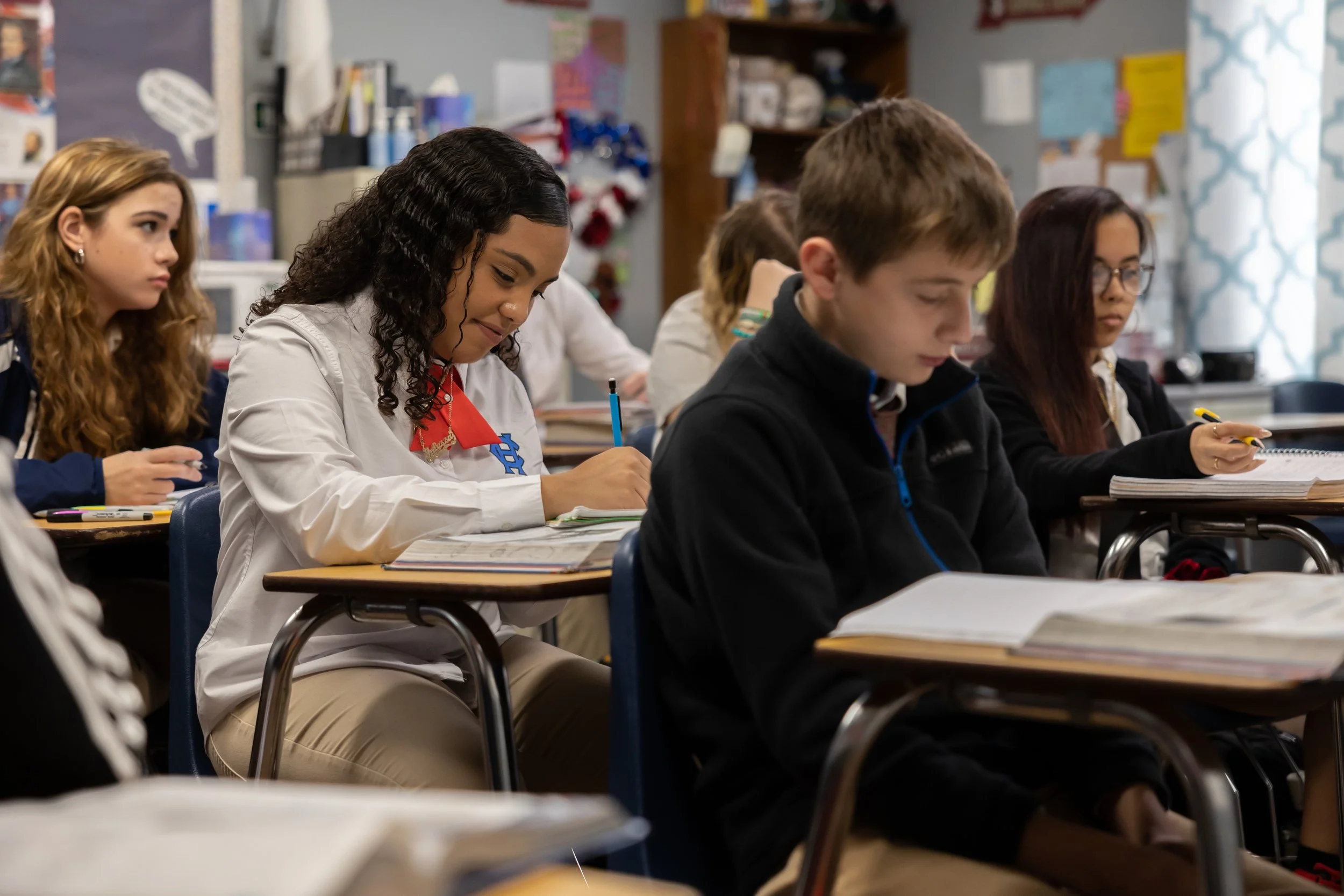
Elementary
Our elementary program builds a strong academic foundation while nurturing spiritual growth and character development. Students engage in structured, teacher-led instruction using proven curriculum designed to support a wide range of learning styles.

Bible
Overview:
The K–5 Bible program provides a foundational understanding of Scripture, focusing on God’s character, His redemptive plan, and the application of biblical truth in everyday life. Using Purposeful Design Bible (ACSI) and BJU Press resources, students engage with key Bible stories, memory verses, and doctrinal themes that build a cohesive understanding of the Old and New Testaments. Instruction emphasizes not only knowledge of Scripture but also heart transformation, helping students develop a growing relationship with Christ and a biblical worldview at an early age.
Key Focus Areas:
Overview of major Bible narratives from Genesis to Revelation, understanding God’s character and attributes, introduction to foundational doctrines such as creation, sin, salvation, and grace, Scripture memory and application, development of a biblical worldview, practical Christian living including obedience, kindness, and integrity
Learning Outcomes:
Students recall and retell key Bible stories and explain their significance within God’s redemptive plan, students identify core attributes of God and describe how they are revealed in Scripture, students demonstrate understanding of foundational biblical doctrines including creation, sin, and salvation, students apply biblical principles to daily decisions and relationships, students develop habits of Scripture memory, prayer, and personal reflection appropriate to their age.
Spiritual Integration:
Students are guided to understand that all Scripture is given by God and is applicable to their lives (2 Timothy 3:16–17). Through consistent exposure to God’s Word, students begin to develop a love for Scripture and a desire to live according to its truth (Psalm 119:105). The course encourages students to grow in Christlike character, recognizing their identity as part of God’s creation and His plan (Ephesians 2:10).
English / Language Arts
Overview:
The K–5 English Language Arts program develops foundational literacy skills through a structured and systematic approach using the Abeka curriculum. Students build proficiency in phonics, reading comprehension, grammar, writing, and vocabulary while engaging with a wide range of age-appropriate literature. Instruction emphasizes fluency, accuracy, and expression, equipping students with the skills needed to read critically, write clearly, and communicate effectively across all subject areas.
Key Focus Areas:
Phonics and word recognition, reading fluency and comprehension, grammar and language conventions, vocabulary development, written composition and sentence structure, listening and speaking skills, engagement with fiction and nonfiction texts
Learning Outcomes:
Students demonstrate mastery of phonics and decoding strategies appropriate to grade level, students read with fluency, accuracy, and comprehension across a variety of texts, students apply grammar and language conventions in both written and spoken communication, students write clearly using complete sentences and organized ideas, students build and apply vocabulary to enhance understanding and expression, students engage with literature to develop critical thinking and interpretation skills.
Spiritual Integration:
Students are encouraged to use language as a gift from God to communicate truth, encouragement, and wisdom (Proverbs 18:21). Through reading and writing, students develop discernment and an understanding of truth aligned with Scripture (Philippians 4:8). The program reinforces the importance of integrity, kindness, and clarity in communication, reflecting Christlike character in both words and actions.
Supplemental Learning
Overview:
Supplemental Learning enhances core instruction through the use of Scholastic News, a weekly, age-appropriate publication that connects current events to classroom learning. Students engage with nonfiction texts that introduce real-world topics while building reading comprehension, vocabulary, and critical thinking skills. The program supports literacy development by helping students apply reading strategies to authentic, relevant content.
Key Focus Areas:
Nonfiction reading and text features, comprehension of current events and real-world topics, vocabulary development in context, critical thinking and discussion, connection of classroom learning to real-world situations, development of reading strategies for informational texts
Learning Outcomes:
Students read and comprehend grade-level nonfiction texts, students identify key ideas and supporting details in informational articles, students apply reading strategies to understand real-world topics, students build vocabulary through context and exposure to current events, students engage in discussion and demonstrate understanding of content, students connect classroom concepts to real-world situations.
Spiritual Integration:
Students are encouraged to engage with the world around them thoughtfully and with discernment (Romans 12:2). As they explore current events, students are guided to think critically, seek truth, and respond with wisdom and compassion (Micah 6:8), recognizing their role in understanding and positively influencing the world around them.
Math
Overview:
The K–5 Mathematics program builds a strong foundation in mathematical understanding through a structured, sequential approach using BJU Press curriculum. Students develop number sense, computational fluency, and problem-solving skills while engaging with concepts that progress from concrete to abstract. Instruction emphasizes accuracy, reasoning, and real-world application, equipping students with the skills and confidence needed for continued success in mathematics.
Key Focus Areas:
Number sense and place value, addition, subtraction, multiplication, and division, fractions and decimals, measurement and data, geometry and spatial reasoning, problem-solving strategies, development of mathematical reasoning and fluency
Learning Outcomes:
Students demonstrate fluency with grade-level mathematical operations, students apply place value understanding to solve problems, students solve multi-step problems using appropriate strategies, students understand and apply concepts of fractions and decimals, students analyze and interpret data and measurement, students explain mathematical thinking and reasoning clearly
Spiritual Integration:
Students recognize that mathematics reflects order, consistency, and truth within God’s creation (1 Corinthians 14:33). Through problem-solving and practice, students develop perseverance and diligence (Proverbs 21:5), learning to approach challenges with patience and integrity while striving for excellence in their work (Colossians 3:23).
Science
Overview:
The K–5 Science program builds foundational scientific understanding through a structured, hands-on approach using BJU Press curriculum. Students explore life, earth, and physical science concepts while developing skills in observation, inquiry, and critical thinking. Instruction emphasizes curiosity, exploration, and real-world connections, helping students understand the natural world and the principles that govern it.
Key Focus Areas:
Introduction to life, earth, and physical science concepts, observation and scientific inquiry, basic understanding of plants, animals, and human body systems, weather, space, and the environment, properties of matter and energy, simple experiments and hands-on investigation, development of scientific vocabulary and reasoning
Learning Outcomes:
Students observe and describe the natural world using appropriate scientific vocabulary, students ask questions and investigate through simple experiments, students identify basic characteristics of living and nonliving things, students explain foundational concepts related to weather, space, and matter, students apply observation and reasoning to understand scientific ideas, students demonstrate curiosity and engagement in exploring scientific concepts.
Spiritual Integration:
Students are encouraged to recognize the natural world as part of God’s creation, reflecting His power and creativity (Psalm 19:1). Through exploration and discovery, students develop a sense of wonder and appreciation for the order and design found in creation (Genesis 1:31). The course reinforces the importance of stewardship and responsibility in caring for the world around them (Genesis 2:15).
Social Studies
Overview:
The K–5 Social Studies program introduces students to history, geography, civics, and economics through a structured and engaging approach using BJU Press Heritage Studies and Florida Studies Weekly (grades 3–5). Students explore communities, cultures, and historical events while developing an understanding of how people and systems interact over time. Instruction emphasizes critical thinking, citizenship, and real-world connections, helping students build a foundational understanding of society at the local, state, and global levels.
Key Focus Areas:
Introduction to history, geography, civics, and economics, study of communities and cultural diversity, understanding local, state, and national history including Florida history, basic principles of citizenship and government, map skills and geographic awareness, development of inquiry and critical thinking skills
Learning Outcomes:
Students identify key historical events and figures and explain their significance, students describe geographic features and use basic map skills, students explain the roles and responsibilities of citizens in a community, students demonstrate understanding of local and state history including Florida-specific content, students compare cultures and recognize diversity within communities, students apply critical thinking skills to understand how people and events shape society.
Spiritual Integration:
Students are encouraged to understand their role within God’s creation and their responsibility to others (Micah 6:8). Through the study of history and cultures, students recognize the value and dignity of all people as created in God’s image (Genesis 1:27). The course reinforces principles of respect, responsibility, and service, guiding students to be thoughtful and compassionate members of their communities.
Middle School Courses
Middle school at Hernando Christian Academy helps students strengthen academic skills while developing independence, responsibility, and deeper critical thinking. Instruction remains structured and teacher-led, while preparing students for the increased expectations of high school.
Bible 6
Overview:
Bible 6 provides a comprehensive overview of all 66 books of the Bible using the Route 66 curriculum. Students explore the structure, themes, and key messages of each book, gaining a clear understanding of how Scripture fits together as one unified account of God’s redemptive plan. The course emphasizes both biblical literacy and personal application, helping students see how God’s Word speaks into every area of life and shapes a Christ-centered worldview.
Key Focus Areas:
Survey of all 66 books of the Bible, major themes and key events across Old and New Testaments, understanding the Bible as a unified narrative of redemption, authorship and historical context of Scripture, application of biblical truth to daily life, development of personal engagement with God’s Word
Learning Outcomes:
Students identify the structure and key themes of each book of the Bible, students explain how individual books contribute to the overarching narrative of Scripture, students demonstrate understanding of major biblical events and their significance, students apply biblical principles to personal decisions and relationships, students develop confidence in navigating and studying the Bible independently.
Spiritual Integration:
Students are encouraged to see Scripture as a unified and living Word that reveals God’s character and plan (Luke 24:27). As they study the full scope of the Bible, students are challenged to hide God’s Word in their hearts and apply it daily (Psalm 119:11), recognizing that Scripture is foundational for wisdom, direction, and spiritual growth (Joshua 1:8).
Following Christ
Overview:
Following Christ provides an in-depth study of the life and ministry of Jesus through the Gospel accounts, using The God-Man: Christ in the Gospels as a primary text. Students examine the teachings, miracles, and mission of Christ while also exploring selected epistles that establish and explain foundational Christian doctrine. The course emphasizes both understanding who Jesus is and what it means to follow Him, helping students connect biblical truth to personal faith and daily living.
Key Focus Areas:
Study of the life and ministry of Jesus through the Gospels, analysis of Christ’s teachings, parables, and miracles, understanding the identity of Jesus as fully God and fully man, examination of key epistles and their role in establishing Christian doctrine, application of biblical truth to personal faith and daily decisions, development of a Christ-centered worldview
Learning Outcomes:
Students explain the key events and themes found in the Gospel accounts of Jesus’ life, students analyze the teachings and parables of Christ and their application to life, students articulate the significance of Jesus as both fully God and fully man, students demonstrate understanding of foundational doctrines presented in selected epistles, students apply the teachings of Christ to personal decisions and relationships, students develop a growing understanding of what it means to follow Christ in everyday life.
Spiritual Integration:
Students are challenged to not only study Christ but to follow Him, recognizing His call to discipleship (Luke 9:23). Through the Gospels and epistles, students see the example of Christ’s life and the expectations for believers, encouraging them to grow in faith, obedience, and love (John 13:34–35). The course reinforces the truth that a relationship with Christ transforms both belief and behavior, shaping how students live and interact with others.
Wisdom of Proverbs
Overview:
Wisdom of Proverbs guides students through a practical study of biblical wisdom using Wise Up: Wisdom of Proverbs. This course explores how God’s Word provides clear, relevant direction for everyday life, focusing on decision-making, relationships, speech, and character. Students learn to recognize the contrast between wisdom and foolishness and are equipped to apply biblical truth to real-life situations they face during their formative middle school years.
Key Focus Areas:
Biblical wisdom versus worldly thinking, decision-making and discernment, relationships and peer influence, speech and communication, character development and personal responsibility, consequences of choices and moral integrity
Learning Outcomes:
Students explain key themes and teachings found in the book of Proverbs, students apply biblical wisdom to real-life situations and personal decisions, students evaluate choices based on Scripture rather than emotion or peer influence, students demonstrate understanding of the relationship between actions and consequences, students develop discernment in areas such as friendships, speech, and behavior, students articulate how God’s wisdom provides guidance for daily life.
Spiritual Integration:
Students are encouraged to seek wisdom as a priority, recognizing that true understanding begins with the fear of the Lord (Proverbs 9:10). Through the study of Proverbs, students learn to trust God’s guidance over their own understanding (Proverbs 3:5–6) and to pursue lives marked by integrity, self-control, and righteousness. The course challenges students to consistently turn to Scripture as the first and best source of truth in every situation (James 1:5).
Language Arts I
Overview:
Language Arts 1 develops foundational skills in reading, writing, speaking, and language through structured instruction using BJU Press curriculum. Students engage with a variety of literary and informational texts while strengthening comprehension, vocabulary, and written expression. The course emphasizes organization, clarity, and the use of textual evidence to support ideas, preparing students for more advanced analysis in later grades.
Key Focus Areas:
Reading comprehension of literary and informational texts, identification of central idea and supporting details, introduction to literary elements and text structure, development of paragraph and short essay writing, grammar and usage, vocabulary development, speaking and listening skills
Learning Outcomes:
Students identify central ideas and supporting details in grade-level texts, students analyze basic literary elements such as plot, setting, and character, students write organized paragraphs with clear topic sentences and supporting details, students apply grammar and language conventions in writing, students use evidence from texts to support responses, students demonstrate effective listening and speaking skills in discussions.
Spiritual Integration:
Students are encouraged to pursue wisdom and understanding through reading and communication (Proverbs 4:7). As they develop language skills, students learn to use words with purpose and integrity, reflecting truth and encouragement in their communication (Ephesians 4:29).
Language Arts II
Overview:
Language Arts 2 builds on foundational literacy skills by increasing text complexity and strengthening analytical and writing abilities through BJU Press curriculum. Students engage more deeply with literary and informational texts, focusing on interpretation, author’s purpose, and structured written responses. The course emphasizes clarity, organization, and the consistent use of evidence to support ideas.
Key Focus Areas:
Analysis of theme and author’s purpose, comparison of texts and ideas, development of multi-paragraph writing, use of textual evidence to support analysis, grammar and sentence structure, vocabulary expansion, speaking and collaborative discussion skills
Learning Outcomes:
Students analyze themes and explain how they are developed in texts, students evaluate author’s purpose and point of view, students write multi-paragraph responses with clear organization and supporting evidence, students compare and contrast ideas across texts, students apply grammar and language conventions with increasing consistency, students participate effectively in discussions and collaborative activities.
Spiritual Integration:
Students are challenged to think critically and evaluate ideas with discernment (Romans 12:2). Through reading and discussion, students develop the ability to recognize truth and communicate thoughtfully, demonstrating wisdom and respect in their interactions (Colossians 4:6).
Language Arts III
Overview:
Language Arts 3 prepares students for the transition to high school by emphasizing advanced comprehension, analytical thinking, and structured writing through BJU Press curriculum. Students engage with complex texts and refine their ability to analyze, interpret, and evaluate ideas. The course focuses on building independence in reading and writing while developing the skills necessary for high school-level expectations.
Key Focus Areas:
Analysis of complex literary and informational texts, evaluation of argument and author’s perspective, development of structured essays including argumentative and informative writing, synthesis of information from multiple sources, advanced grammar and language usage, preparation for high school-level reading and writing
Learning Outcomes:
Students analyze complex texts and explain how ideas are developed and supported, students evaluate arguments and identify claims and evidence, students write structured essays with clear organization and well-supported ideas, students synthesize information from multiple texts to form conclusions, students apply grammar and language conventions with accuracy, students demonstrate readiness for high school-level reading, writing, and analysis.
Spiritual Integration:
Students are encouraged to pursue truth with discernment and wisdom (James 1:5). As they evaluate ideas and perspectives, students are challenged to align their thinking with biblical truth and communicate with integrity, clarity, and purpose (Philippians 4:8).
Pre-Algebra
Overview:
Pre-Algebra develops the foundational skills and conceptual understanding necessary for success in Algebra and higher-level mathematics. Using the Mathspace platform, students engage in adaptive, interactive learning that reinforces concepts through guided practice and immediate feedback. The course emphasizes the transition from arithmetic to algebraic thinking, focusing on problem-solving, reasoning, and the application of mathematical concepts in real-world contexts.
Key Focus Areas:
Operations with integers and rational numbers, expressions and equations, ratios, proportions, and percent, introduction to functions and graphing, basic geometry and measurement, problem-solving strategies and mathematical reasoning, personalized skill development through adaptive learning pathways
Learning Outcomes:
Students perform operations with integers, fractions, and decimals with accuracy, students simplify and evaluate algebraic expressions, students solve one-step and multi-step equations and inequalities, students apply ratios, proportions, and percent to real-world problems, students interpret and create basic graphs and understand functional relationships, students demonstrate readiness for Algebra through increased confidence and accuracy in problem-solving.
Spiritual Integration:
Students are encouraged to approach challenges with perseverance and diligence, recognizing that growth comes through effort and discipline (Galatians 6:9). As they develop mathematical reasoning, students see the order and consistency of creation reflected in mathematical principles (1 Corinthians 14:33), and are challenged to pursue excellence and integrity in their work (Colossians 3:23).
Algebra I
Overview:
Algebra 1 introduces students to foundational algebraic concepts using the Mathspace curriculum, which combines interactive problem-solving with immediate feedback and guided instruction. Students develop a deep understanding of variables, expressions, equations, and functions while building the skills needed to model and solve real-world problems. The course emphasizes conceptual understanding, procedural fluency, and the application of mathematical reasoning.
Key Focus Areas:
Variables and algebraic expressions, solving linear equations and inequalities, graphing and interpreting linear functions, systems of equations, exponents and polynomials, introduction to quadratic relationships, real-world problem solving using algebraic models
Learning Outcomes:
Students solve linear equations and inequalities and justify their solutions, students interpret and graph linear functions and analyze relationships between variables, students apply algebraic methods to solve real-world problems, students simplify and operate with polynomials, students analyze patterns and relationships using mathematical reasoning, students demonstrate foundational readiness for higher-level mathematics including Geometry and Algebra 2.
Spiritual Integration:
Students are encouraged to recognize the order, consistency, and logic found in mathematics as a reflection of God’s character (1 Corinthians 14:33). The course promotes perseverance, diligence, and integrity in problem-solving (Colossians 3:23), while helping students develop confidence in using their God-given abilities to think critically and solve problems.
Life Science
Overview:
Life Science introduces students to the study of living organisms and biological systems using the Abeka curriculum. Students explore foundational concepts including cell structure, genetics, classification, ecosystems, and human body systems. The course emphasizes observation, classification, and scientific reasoning, helping students understand how living things function, interact, and adapt within their environments while building a strong foundation for future science courses.
Key Focus Areas:
Cell structure and function, classification of living organisms, genetics and heredity, ecosystems and environmental interactions, human body systems, scientific observation and investigation, relationships between structure and function in living things
Learning Outcomes:
Students describe the structure and function of cells and explain their role in living organisms, students classify organisms based on shared characteristics, students explain basic principles of genetics and heredity, students analyze relationships within ecosystems and the impact of environmental changes, students identify major human body systems and their functions, students apply scientific observation and reasoning to understand biological processes
Spiritual Integration:
Students explore the complexity and diversity of life as evidence of God’s intentional design (Genesis 1:21). The study of living systems highlights the order and purpose within creation, encouraging students to recognize God’s wisdom and creativity (Psalm 104:24). Students are challenged to value life and act as responsible stewards of the natural world (Genesis 2:15).
Physical Science
Overview:
Physical Science introduces students to the fundamental principles that govern matter and energy using the Purposeful Design (ACSI) curriculum. Students explore concepts in physics and chemistry, including motion, forces, energy, and the properties of matter, while developing scientific reasoning and problem-solving skills. The course is designed to build conceptual understanding through observation, experimentation, and real-world application, preparing students for more advanced science courses in high school.
Key Focus Areas:
Properties and states of matter, atomic structure and basic chemistry concepts, motion, forces, and Newton’s laws, forms and transfer of energy, waves and sound, introduction to simple machines, scientific investigation and experimental design
Learning Outcomes:
Students describe the properties and behavior of matter and its different states, students explain basic atomic structure and chemical interactions, students analyze motion and forces using foundational physics principles, students identify and explain different forms of energy and how energy is transferred, students apply scientific reasoning to experiments and interpret results, students demonstrate understanding of how physical science concepts apply to real-world situations.
Spiritual Integration:
Students explore the laws and consistency of the physical world as evidence of God’s order and design (Jeremiah 33:25). Through the study of matter and energy, students recognize the reliability and structure of creation, pointing to a purposeful Creator. The course encourages curiosity, careful observation, and responsible stewardship of the physical world (Genesis 1:28), reinforcing the connection between scientific understanding and biblical truth.
Earth Science
Overview:
Earth Science introduces students to the structure, systems, and processes of the Earth using the Abeka curriculum. Students explore topics including geology, meteorology, oceanography, and astronomy, developing an understanding of how Earth’s systems interact and change over time. The course emphasizes observation, classification, and scientific reasoning, helping students interpret the natural world while building a foundation for future scientific study.
Key Focus Areas:
Structure and composition of the Earth, rocks and minerals, weather and atmospheric systems, water cycle and oceanography, introduction to astronomy and the solar system, natural processes such as erosion and plate movement, scientific observation and classification
Learning Outcomes:
Students describe the structure and layers of the Earth and explain key geological processes, students identify and classify rocks, minerals, and natural resources, students explain weather patterns and the factors that influence climate, students describe the water cycle and the role of oceans in Earth’s systems, students demonstrate understanding of basic astronomy concepts including the solar system, students apply observation and data interpretation skills to understand changes in Earth’s systems.
Spiritual Integration:
Students explore the Earth as part of God’s intentional and ordered creation (Genesis 1:1). The study of natural systems reveals consistency and design, pointing to God’s power and creativity (Psalm 19:1). Students are encouraged to be good stewards of the Earth and its resources (Genesis 2:15), recognizing their responsibility to care for creation with wisdom and respect.
World Cultures
Overview:
World Cultures introduces students to the people, regions, and traditions of the world through the BJU Press curriculum. Students explore geographic, cultural, historical, and religious aspects of various regions, developing an understanding of how people live and interact across the globe. The course emphasizes a biblical worldview, helping students evaluate cultural practices while recognizing both the diversity of humanity and the shared need for truth found in God’s Word.
Key Focus Areas:
Geography and world regions, cultural traditions and societal structures, basic economic and governmental systems, historical influences on modern cultures, comparison of worldviews and belief systems, global awareness and cultural understanding
Learning Outcomes:
Students identify major world regions and describe their geographic and cultural characteristics, students explain how geography influences culture and daily life, students compare cultural practices and belief systems from a biblical perspective, students analyze how history shapes modern societies, students demonstrate an understanding of global diversity and interconnectedness, students evaluate cultural ideas using discernment grounded in Scripture.
Spiritual Integration:
Students are taught to view all cultures through the lens of Scripture, recognizing that all people are created in God’s image (Genesis 1:27) while also discerning truth from error (Acts 17:26–27). The course encourages students to develop compassion, humility, and a heart for others, understanding God’s desire for all nations to know Him (Matthew 28:19). Students are challenged to think critically about worldviews and align their understanding with biblical truth (Romans 12:2).
U.S. History
Overview:
U.S. History introduces students to the major events, people, and ideas that shaped the development of the United States using BJU Press curriculum. Students explore key periods from early exploration through the formation and growth of the nation, building foundational knowledge of historical concepts and timelines. The course emphasizes comprehension, cause-and-effect relationships, and the development of basic historical thinking skills.
Key Focus Areas:
Early exploration and colonization, founding of the United States and the Constitution, westward expansion and national growth, major conflicts including the Civil War, introduction to civic principles and citizenship, development of historical timelines and context
Learning Outcomes:
Students identify key events and figures in U.S. history and explain their significance, students describe cause-and-effect relationships in historical events, students explain foundational principles such as democracy and citizenship, students demonstrate understanding of major historical periods and timelines, students analyze basic primary and secondary sources, students build foundational historical thinking and comprehension skills.
Spiritual Integration:
Students examine the development of the nation through a biblical lens, recognizing the importance of justice, leadership, and responsibility (Micah 6:8). The course encourages students to understand the role of individuals and decisions in shaping history, while reflecting on God’s sovereignty throughout human events (Proverbs 21:1).
Civics
Overview:
Civics provides students with a foundational understanding of the structure and function of government, with an emphasis on the principles of American democracy. Using Florida Transformative Education curriculum resources, students explore the origins of government, the Constitution, and the rights and responsibilities of citizens. The course emphasizes critical thinking, analysis of primary sources, and real-world application, preparing students to engage thoughtfully and responsibly in civic life.
Key Focus Areas:
Foundations of government and political systems, principles and structure of the U.S. Constitution, roles and responsibilities of the three branches of government, rights and responsibilities of citizens, analysis of primary and secondary sources, civic participation and decision-making
Learning Outcomes:
Students explain the structure and function of local, state, and federal government, students analyze the principles and protections outlined in the Constitution and Bill of Rights, students evaluate the roles and powers of each branch of government, students interpret primary source documents and apply them to modern contexts, students demonstrate understanding of the rights and responsibilities of citizenship, students apply critical thinking skills to civic issues and decision-making.
Spiritual Integration:
Students examine the concept of justice, authority, and responsibility through a biblical lens, recognizing that all authority is established by God (Romans 13:1). The course encourages students to act justly, love mercy, and walk humbly (Micah 6:8) as they consider their role in society. Students are challenged to be informed, responsible citizens who seek truth, uphold integrity, and contribute positively to their communities.
High School Courses
Hernando Christian Academy's high school program equips students in grades 9–12 with the academic rigor, critical thinking skills, and spiritual maturity needed to thrive in college and beyond. Our curriculum is designed with college preparation in mind, offering a comprehensive course selection across core academics and enriching electives.
Apologetics
Overview:
Apologetics equips students to understand, articulate, and defend the Christian faith with clarity and confidence. Drawing from Reasons We Believe and Spiritual Disciplines for the Christian Life Study Guide, students examine the reliability of Scripture, the evidence for God’s existence, and the historical foundation of Christianity. The course emphasizes both intellectual engagement and spiritual formation, helping students develop a thoughtful, well-reasoned faith that can be applied in everyday conversations and challenges.
Key Focus Areas:
Biblical authority and reliability, evidence for the existence of God, historical evidence for Jesus Christ and the resurrection, worldview analysis and comparison, responding to common objections to Christianity, development of personal spiritual disciplines
Learning Outcomes:
Students articulate a clear and reasoned defense of the Christian faith using biblical and historical evidence, students evaluate competing worldviews through a biblical lens, students respond thoughtfully to common objections and questions about Christianity, students demonstrate understanding of the reliability and authority of Scripture, students apply spiritual disciplines to strengthen personal faith and consistency in daily life.
Spiritual Integration:
Students are challenged to “always be prepared to give an answer…for the hope that you have” (1 Peter 3:15), developing both conviction and humility in their defense of the faith. Through the practice of spiritual disciplines, students grow in their relationship with Christ (1 Timothy 4:7–8), recognizing that a strong defense of the faith is rooted not only in knowledge but in a transformed life.
Church History
Overview:
Church History provides a chronological study of the development of Christianity from the early church to the modern era, using Christian History Made Easy as a foundational resource. Students examine key events, figures, and movements that have shaped the global Church, including the early church, the Reformation, and the spread of Christianity worldwide. The course highlights God’s faithfulness throughout history and the impact of believers who have stood firm in their faith across generations.
Key Focus Areas:
Early church formation and persecution, key leaders and theological developments, the Reformation and its impact, expansion of Christianity globally, major movements and denominational distinctions, historical context of doctrinal development
Learning Outcomes:
Students identify and explain major events and figures in the history of the Church, students analyze how historical context influenced theological developments, students describe the significance of the Reformation and its lasting impact, students connect historical movements to present-day expressions of Christianity, students evaluate the role of faithfulness and perseverance in the lives of key Christian leaders.
Spiritual Integration:
Students reflect on the faithfulness of believers throughout history who endured hardship and remained steadfast (Hebrews 12:1). The course encourages students to see themselves as part of the ongoing story of the Church, called to live out their faith with courage and conviction (Matthew 28:19–20), recognizing God’s sovereignty and guidance across generations.
Old Testament Bible
Overview:
Old Testament Bible provides a comprehensive study of the people, events, and themes of the Old Testament, emphasizing God’s unfolding plan of redemption leading to the coming of Christ. Students examine key narratives, covenant relationships, and major figures while developing an understanding of how the Old Testament lays the foundation for the New Testament. The course focuses on both biblical literacy and theological understanding, helping students see Scripture as a unified account of God’s purpose and promises.
Key Focus Areas:
Study of major Old Testament narratives and historical events, examination of key figures such as Abraham, Moses, David, and the prophets, understanding of covenant relationships and God’s promises, exploration of themes including creation, fall, redemption, and restoration, connection of Old Testament prophecy to the coming of Christ, development of biblical literacy and contextual understanding
Learning Outcomes:
Students identify and explain key events and figures of the Old Testament, students analyze major themes and their significance within God’s redemptive plan, students describe covenant relationships and their role in biblical history, students explain how Old Testament prophecy points to the coming of Jesus Christ, students demonstrate understanding of how the Old Testament connects to and supports the New Testament, students apply biblical principles from Old Testament teachings to personal faith and life.
Spiritual Integration:
Students are encouraged to see God’s faithfulness and sovereignty throughout the Old Testament (Deuteronomy 7:9). As they study Scripture, students recognize how God’s promises are fulfilled in Christ (Luke 24:44), strengthening their understanding of the Bible as one unified story. The course challenges students to trust in God’s plan and live with obedience and faith (Joshua 1:8).
Philosophy/Ethics
Overview:
Philosophy and Ethics challenges students to examine major life questions, moral dilemmas, and competing worldviews through the lens of Scripture. Using the Bible and What’s Your Worldview, students explore foundational philosophical ideas and ethical systems while comparing them to a biblical framework. The course emphasizes critical thinking, reflection, and the application of truth, equipping students to navigate complex cultural and moral issues with clarity and conviction.
Key Focus Areas:
Study of major philosophical questions and ethical issues, comparison of worldviews including secular and biblical perspectives, analysis of moral decision-making and ethical frameworks, evaluation of truth, meaning, and purpose, application of biblical principles to contemporary issues, development of critical thinking and reasoning skills
Learning Outcomes:
Students analyze major philosophical and ethical questions and articulate reasoned responses, students compare and contrast different worldviews with a biblical perspective, students evaluate ethical dilemmas using sound reasoning and biblical principles, students defend a biblical worldview with clarity and confidence, students apply critical thinking skills to real-world cultural and moral issues, students demonstrate the ability to engage thoughtfully and respectfully with differing perspectives.
Spiritual Integration:
Students are encouraged to seek wisdom and truth as revealed in God’s Word (Colossians 2:8). As they evaluate competing worldviews, students are challenged to stand firm in their faith while engaging others with humility and grace (1 Peter 3:15). The course reinforces the belief that truth is found in Christ and that a biblical worldview provides a foundation for understanding life, purpose, and morality (John 14:6).
Theology/Life of Christ
Overview:
This course provides a comprehensive study of core Christian doctrines alongside an in-depth examination of the Gospel of John. Using the Bible, Essential Truths of the Christian Faith, and John: A 12-Week Study, students explore the foundational beliefs of Christianity and how they are rooted in Scripture. The course emphasizes theological synthesis, helping students connect key doctrines to the life and teachings of Christ while developing a deeper, more coherent understanding of their faith.
Key Focus Areas:
Study of major Christian doctrines including God, salvation, grace, and the nature of Christ, in-depth analysis of the Gospel of John, understanding the divinity and humanity of Jesus, development of a biblical framework for theology, connection of doctrine to Scripture, application of theological truth to personal faith and daily life
Learning Outcomes:
Students explain and synthesize major Christian doctrines using biblical support, students analyze the Gospel of John and identify key themes and theological insights, students articulate the significance of Christ’s identity as fully God and fully man, students connect doctrinal concepts directly to Scripture, students apply theological understanding to personal beliefs and decision-making, students demonstrate the ability to think critically about faith and articulate a coherent biblical worldview.
Spiritual Integration:
Students are encouraged to grow in both knowledge and relationship with Christ, recognizing Him as the source of truth and life (John 14:6). Through the study of theology and Scripture, students deepen their understanding of God’s character and their identity in Him (Colossians 2:6–7). The course challenges students to live out their faith with conviction, grounding their beliefs in Scripture and reflecting Christ in their daily lives (James 1:22).
English 1
Overview:
English 1 establishes the foundation for high school literacy through a structured study of grammar, composition, and literature using BJU Press curriculum and novel studies. Students engage with a variety of texts while developing essential skills in reading comprehension, literary analysis, and organized writing. Instruction emphasizes clear communication, proper language usage, and the ability to support ideas with textual evidence.
Key Focus Areas:
Foundational literary analysis including theme, plot, and character, introduction to close reading and text-based evidence, development of structured paragraph and essay writing, grammar and usage through direct instruction, vocabulary development, guided analysis of novels and short texts
Learning Outcomes:
Students identify and analyze key literary elements within a text, students cite relevant textual evidence to support ideas, students write organized paragraphs and essays with clear structure, students apply grammar and language conventions accurately in writing, students demonstrate comprehension of literary and informational texts, students develop confidence in written and verbal communication.
Spiritual Integration:
Students are encouraged to pursue truth and wisdom through literature and language (Proverbs 2:6). Through reading and writing, students develop discernment and integrity in communication, recognizing the importance of using words to reflect truth and build others up (Ephesians 4:29).
English 2
Overview:
English 2 builds on foundational skills through more complex literary analysis and writing, using BJU Press curriculum and novel studies. Students engage with a broader range of texts and refine their ability to interpret meaning, evaluate author’s purpose, and construct well-supported arguments. The course emphasizes consistent application of reading and writing skills aligned to high school standards.
Key Focus Areas:
Analysis of increasingly complex literary and informational texts, development of argumentative and analytical writing, evaluation of author’s purpose and literary techniques, integration of textual evidence into structured responses, continued grammar and composition instruction, novel-based analysis and discussion
Learning Outcomes:
Students analyze complex texts and explain how authors develop ideas and themes, students construct clear and supported argumentative and analytical essays, students evaluate author’s purpose and literary techniques, students consistently integrate relevant textual evidence into writing, students demonstrate proficiency in grammar and composition skills, students communicate ideas with clarity and precision.
Spiritual Integration:
Students are challenged to evaluate ideas with discernment and align their thinking with truth (Philippians 1:9–10). Through literature, students examine themes of truth, morality, and human nature while developing communication that reflects wisdom and grace (Colossians 4:6).
English 3
Overview:
English 3 focuses on American literature and advanced analytical writing through the use of BJU Press curriculum and novel studies. Students examine literary works within their historical and cultural context while developing the ability to analyze rhetoric, evaluate perspectives, and construct research-based arguments. The course emphasizes deeper critical thinking and the synthesis of complex ideas.
Key Focus Areas:
Study of American literature in historical and cultural context, rhetorical analysis of speeches and foundational texts, development of analytical and research-based writing, evaluation of author perspective and bias, synthesis of multiple sources, extended analysis through novel studies
Learning Outcomes:
Students analyze American literature and explain its connection to historical and cultural context, students evaluate rhetorical strategies and their effectiveness, students conduct research and synthesize multiple sources into coherent arguments, students construct well-developed analytical essays with nuanced reasoning, students assess author perspective and bias, students communicate complex ideas with clarity and depth.
Spiritual Integration:
Students examine themes of truth, justice, and human nature through a biblical lens (Micah 6:8). As they encounter diverse perspectives, students are encouraged to think critically while remaining grounded in biblical truth, demonstrating wisdom and discernment (James 1:5).
English 4
Overview:
English 4 prepares students for college and career readiness through advanced study of literature and composition using BJU Press curriculum and novel studies. Students engage with complex texts and produce sophisticated writing that reflects independence, critical thinking, and clarity. The course emphasizes research, synthesis, and real-world application of communication skills.
Key Focus Areas:
Analysis of British and world literature, advanced argumentative and analytical writing, research and synthesis of multiple sources, evaluation of complex themes and perspectives, development of independent reading and writing skills, application of communication in academic and real-world contexts
Learning Outcomes:
Students analyze complex literary and informational texts with independence and depth, students construct advanced argumentative and analytical writing supported by multiple sources, students conduct research and synthesize information into cohesive conclusions, students evaluate complex themes and perspectives across texts, students demonstrate readiness for college-level reading and writing, students communicate effectively in academic and real-world contexts.
Spiritual Integration:
Students are encouraged to pursue excellence and truth in all forms of communication (Colossians 3:23). As they prepare for life beyond high school, students are challenged to think critically, communicate truthfully, and live out their faith with integrity and purpose (Matthew 5:16).
Spanish I
Overview:
Spanish 1 introduces students to the fundamentals of the Spanish language using the Abeka curriculum. Students develop basic skills in speaking, listening, reading, and writing while building vocabulary and understanding foundational grammar structures. The course emphasizes pronunciation, comprehension, and simple communication, helping students begin to engage with the language in meaningful and practical ways.
Key Focus Areas:
Basic vocabulary and conversational phrases, pronunciation and listening comprehension, foundational grammar including verb conjugation and sentence structure, reading and interpreting simple texts, writing basic sentences and responses, introduction to Spanish-speaking cultures
Learning Outcomes:
Students demonstrate basic conversational skills using common vocabulary and phrases, students understand and respond to simple spoken Spanish, students read and interpret introductory-level texts, students write basic sentences using correct grammar and structure, students apply foundational verb conjugations in present tense, students develop awareness of Spanish-speaking cultures and contexts.
Spiritual Integration:
Students are encouraged to see language as a tool for communication and connection, reflecting God’s design for relationships (Acts 2:6–8). As they learn to communicate in another language, students develop respect for different cultures and people, recognizing the value of every individual as created in God’s image (Genesis 1:27).
Spanish II
Overview:
Spanish 2 builds on foundational language skills by expanding vocabulary, refining grammar, and increasing proficiency in communication using the Abeka curriculum. Students engage in more complex speaking, listening, reading, and writing tasks, with an emphasis on sentence structure, verb usage, and comprehension. The course encourages greater fluency and confidence, preparing students to communicate more effectively in real-world situations.
Key Focus Areas:
Expanded vocabulary and conversational skills, more advanced grammar including additional verb tenses, listening comprehension of longer and more complex speech, reading and analyzing intermediate-level texts, writing structured paragraphs and responses, continued exploration of Spanish-speaking cultures
Learning Outcomes:
Students communicate using expanded vocabulary and more complex sentence structures, students understand and interpret spoken Spanish in longer passages, students read and analyze intermediate-level texts with comprehension, students write structured paragraphs with appropriate grammar and verb usage, students apply multiple verb tenses in speaking and writing, students demonstrate increased fluency and confidence in communication.
Spiritual Integration:
Students are encouraged to use language as a means to build relationships and serve others (Philippians 2:4). Through learning another language, students gain a broader perspective of the world and develop appreciation for cultural diversity, reflecting God’s heart for all nations and peoples (Revelation 7:9).
Algebra I
Overview:
Algebra 1 introduces students to foundational algebraic concepts using the Mathspace curriculum, which combines interactive problem-solving with immediate feedback and guided instruction. Students develop a deep understanding of variables, expressions, equations, and functions while building the skills needed to model and solve real-world problems. The course emphasizes conceptual understanding, procedural fluency, and the application of mathematical reasoning.
Key Focus Areas:
Variables and algebraic expressions, solving linear equations and inequalities, graphing and interpreting linear functions, systems of equations, exponents and polynomials, introduction to quadratic relationships, real-world problem solving using algebraic models
Learning Outcomes:
Students solve linear equations and inequalities and justify their solutions, students interpret and graph linear functions and analyze relationships between variables, students apply algebraic methods to solve real-world problems, students simplify and operate with polynomials, students analyze patterns and relationships using mathematical reasoning, students demonstrate foundational readiness for higher-level mathematics including Geometry and Algebra 2.
Spiritual Integration:
Students are encouraged to recognize the order, consistency, and logic found in mathematics as a reflection of God’s character (1 Corinthians 14:33). The course promotes perseverance, diligence, and integrity in problem-solving (Colossians 3:23), while helping students develop confidence in using their God-given abilities to think critically and solve problems.
Geometry
Overview:
Geometry develops students’ understanding of spatial relationships, logical reasoning, and mathematical proof through the study of two- and three-dimensional figures. Using the Mathspace platform, students engage in interactive, adaptive learning that reinforces concepts through guided practice and immediate feedback. The course emphasizes reasoning, precision, and the application of geometric principles to real-world contexts, while building a strong foundation for advanced mathematics.
Key Focus Areas:
Properties of geometric figures and relationships, congruence and similarity, geometric transformations, coordinate geometry, measurement of area, surface area, and volume, introduction to formal proofs and logical reasoning, application of geometry to real-world problem solving through adaptive practice
Learning Outcomes:
Students analyze and classify geometric figures based on their properties, students apply congruence and similarity to solve problems and justify relationships, students use transformations and coordinate geometry to model and analyze figures, students calculate area, surface area, and volume of two- and three-dimensional shapes, students construct and evaluate geometric arguments and proofs, students apply geometric reasoning to real-world and mathematical problems with accuracy and precision.
Spiritual Integration:
Students recognize the order, consistency, and precision of geometric relationships as reflections of God’s design (1 Corinthians 14:33). Through logical reasoning and problem-solving, students are encouraged to pursue truth with clarity and integrity (Proverbs 3:5–6), developing discipline and attention to detail in their work as an act of stewardship (Colossians 3:23).
Algebra II
Overview:
Algebra 2 extends students’ understanding of algebraic concepts by focusing on complex functions, advanced equation solving, and mathematical modeling. Students explore polynomial, rational, exponential, and logarithmic functions, building the analytical skills necessary for higher-level mathematics. The course emphasizes real-world application, critical thinking, and the ability to represent and interpret relationships across multiple forms.
Key Focus Areas:
Analysis and graphing of polynomial, rational, exponential, and logarithmic functions, solving complex equations and systems including nonlinear systems, function transformations and inverse relationships, modeling real-world scenarios using advanced algebraic functions, operations with complex numbers, introduction to sequences and series
Learning Outcomes:
Students represent and analyze a wide variety of functions using graphs, tables, and equations, students solve and interpret solutions to complex and nonlinear equations in context, students apply exponential and logarithmic models to real-world situations such as growth and decay, students demonstrate understanding of function behavior including domain, range, and transformations, students build readiness for Precalculus through deeper abstraction and mathematical reasoning.
Spiritual Integration:
Students are encouraged to recognize the order, structure, and consistency of mathematical systems as reflections of God’s design (1 Corinthians 14:33). Through problem-solving and perseverance, students develop discipline and integrity, aligning their work with Colossians 3:23 working with diligence as unto the Lord. The study of patterns and relationships reinforces the idea that truth is knowable and consistent, pointing to the unchanging nature of God (Hebrews 13:8).
Pre-Calculus
Overview:
Pre-Calculus prepares students for advanced mathematics by deepening their understanding of functions, mathematical relationships, and analytical reasoning. Using the Mathspace platform, students engage in adaptive, interactive learning that supports both conceptual understanding and procedural fluency. The course focuses on extending algebraic and geometric concepts into more complex function analysis and modeling, equipping students with the skills necessary for Calculus and other college-level math courses.
Key Focus Areas:
Advanced analysis of functions including polynomial, rational, exponential, and logarithmic functions, trigonometric functions and identities, graphing and transformations of complex functions, systems of equations and inequalities, sequences and series, mathematical modeling and real-world applications, personalized skill development through adaptive learning pathways
Learning Outcomes:
Students analyze and interpret a wide range of functions and their behaviors, students apply trigonometric concepts and identities to solve problems, students model and solve complex equations and systems, students interpret graphs and transformations of advanced functions, students apply mathematical reasoning to real-world scenarios, students demonstrate readiness for Calculus through independent problem-solving and conceptual understanding.
Spiritual Integration:
Students are encouraged to pursue truth and understanding with diligence, recognizing that God is a God of order and consistency (1 Corinthians 14:33). As they explore complex mathematical relationships, students see the structure and precision of creation, reinforcing a sense of purpose and design. The course challenges students to approach their work with discipline, integrity, and a commitment to excellence (Colossians 3:23).
Foundational Math
Overview:
Foundational Math strengthens essential mathematical skills and conceptual understanding needed for success in higher-level math courses. Using the Mathspace platform, students engage in adaptive, interactive learning that meets them at their current level and builds confidence through guided practice and immediate feedback. The course focuses on reinforcing core concepts in number sense, algebraic reasoning, and problem-solving while developing fluency and accuracy in mathematical processes.
Key Focus Areas:
Number sense and operations, foundational algebraic concepts including expressions and equations, ratios, proportions, and percent, problem-solving strategies and mathematical reasoning, interpretation of graphs and basic functions, personalized skill development through adaptive learning pathways
Learning Outcomes:
Students demonstrate fluency with fundamental mathematical operations and concepts, students solve equations and apply algebraic reasoning to real-world problems, students interpret and analyze graphs and basic functional relationships, students apply problem-solving strategies with increasing independence and accuracy, students identify and address gaps in mathematical understanding through targeted practice, students build confidence and readiness for success in Algebra and other high school math courses
Spiritual Integration:
Students are encouraged to approach learning with diligence and perseverance, recognizing that growth comes through consistent effort (Galatians 6:9). As they develop problem-solving skills, students are reminded that God is a God of order and clarity (1 Corinthians 14:33), and they are called to pursue excellence and integrity in their work (Colossians 3:23).
Personal Finance
Overview:
Personal Finance equips students with essential money management skills through the Dave Ramsey Education curriculum. Using engaging video lessons and practical activities, students explore budgeting, saving, debt avoidance, investing, and consumer decision-making. The course emphasizes real-world application, helping students develop financial habits that promote long-term stability, responsibility, and wise stewardship.
Key Focus Areas:
Budgeting and financial planning, saving and emergency fund development, debt avoidance and responsible credit use, investing and long-term wealth building, consumer awareness and decision-making, understanding income, taxes, and financial systems
Learning Outcomes:
Students create and manage a personal budget based on income and expenses, students develop strategies for saving and building financial security, students evaluate the risks and consequences of debt and credit use, students explain basic investment principles and long-term financial growth, students analyze consumer choices and financial decisions, students demonstrate financial habits that support responsible and independent living.
Spiritual Integration:
Students are encouraged to view money as a resource entrusted to them by God, emphasizing stewardship, discipline, and wise decision-making (Luke 16:10). The course reinforces principles of contentment, generosity, and planning (Proverbs 21:5), guiding students to honor God through responsible financial choices and a long-term perspective on wealth.
Math for College Algebra
Overview:
Math for College Algebra prepares students for success in postsecondary mathematics by strengthening algebraic reasoning and problem-solving skills using the Mathspace platform. Through adaptive, interactive instruction, students review and deepen their understanding of key concepts required for College Algebra, including functions, equations, and mathematical modeling. The course emphasizes conceptual understanding, procedural fluency, and real-world application, ensuring students are equipped for college-level expectations.
Key Focus Areas:
Algebraic expressions and equations, functions and their representations, linear, quadratic, and exponential relationships, graphing and interpreting functions, systems of equations and inequalities, mathematical modeling and real-world problem solving, personalized skill development through adaptive learning pathways
Learning Outcomes:
Students simplify and manipulate algebraic expressions with accuracy, students solve and analyze linear, quadratic, and exponential equations, students interpret and graph functions in multiple forms, students solve systems of equations and apply them to real-world contexts, students apply mathematical reasoning to model and solve complex problems, students demonstrate readiness for College Algebra through independent and accurate problem-solving.
Spiritual Integration:
Students are encouraged to approach learning with discipline and perseverance, recognizing that growth comes through consistent effort (Galatians 6:9). As they engage with mathematical concepts, students see the order and consistency of creation reflected in mathematical relationships (1 Corinthians 14:33), and are challenged to pursue excellence and integrity in their work (Colossians 3:23).
Math for Data and Financial Literacy
Overview:
Math for Data and Financial Literacy applies mathematical concepts to real-world financial and data-driven situations using a Financial Algebra curriculum. Students explore topics such as budgeting, banking, credit, investing, and data analysis while strengthening algebraic reasoning and problem-solving skills. The course emphasizes practical application, equipping students with the tools needed to make informed financial decisions and interpret data in everyday life.
Key Focus Areas:
Personal finance including budgeting, saving, and financial planning, banking systems and credit management, interest, loans, and investments, analysis and interpretation of data, use of algebraic reasoning in financial contexts, consumer decision-making and risk evaluation
Learning Outcomes:
Students create and analyze budgets and financial plans, students calculate and interpret interest, loans, and investment growth, students evaluate credit and financial risk, students interpret and analyze data to make informed decisions, students apply algebraic reasoning to real-world financial scenarios, students demonstrate financial literacy skills necessary for independent living.
Spiritual Integration:
Students are encouraged to view financial resources as a responsibility entrusted by God, emphasizing stewardship, wisdom, and accountability (Luke 16:10). The course reinforces principles of diligence, wise planning, and contentment (Proverbs 21:5), guiding students to make decisions that reflect integrity and long-term perspective.
Biology
Overview:
Biology provides a comprehensive study of living organisms, emphasizing the complexity, organization, and interdependence of life. Using the Abeka curriculum, students explore foundational concepts in cellular biology, genetics, ecology, and human anatomy while developing scientific reasoning and analytical skills. The course highlights the order and design evident in living systems, encouraging students to examine scientific concepts through observation, experimentation, and a structured understanding of biological processes.
Key Focus Areas:
Cell structure and function, genetics and heredity, classification of living organisms, ecology and environmental systems, human anatomy and physiology, scientific investigation and lab-based inquiry, analysis of biological systems and processes
Learning Outcomes:
Students describe the structure and function of cells and major biological systems, students explain principles of genetics and inheritance, students classify organisms based on shared characteristics, students analyze relationships within ecosystems and environmental systems, students interpret data from experiments and apply scientific reasoning to biological questions, students demonstrate understanding of human body systems and their functions.
Spiritual Integration:
Students examine the complexity and order of living organisms as evidence of intentional design (Romans 1:20). The study of life reinforces the belief that all creation reflects God’s wisdom and purpose, encouraging students to steward the natural world responsibly (Genesis 2:15). Students are challenged to approach scientific study with integrity and humility, recognizing God as the ultimate source of truth (Colossians 1:16–17).
Chemistry
Overview:
Chemistry provides a rigorous study of the composition, structure, and interactions of matter, using the Abeka curriculum as a foundation. Students explore atomic theory, chemical bonding, reactions, and the principles that govern physical and chemical changes. The course emphasizes problem-solving, quantitative reasoning, and laboratory investigation, equipping students to understand and apply chemical concepts in real-world contexts while developing a deeper appreciation for the order and consistency found in the physical world.
Key Focus Areas:
Atomic structure and periodicity, chemical bonding and molecular structure, chemical reactions and stoichiometry, states of matter and thermodynamics, solutions and chemical equilibrium, laboratory investigation and scientific measurement, application of chemistry to real-world systems
Learning Outcomes:
Students describe the structure of atoms and explain periodic trends, students analyze and predict chemical bonding and molecular interactions, students balance and interpret chemical equations and apply stoichiometric relationships, students explain the properties and behavior of different states of matter, students apply principles of thermodynamics and equilibrium to chemical systems, students conduct and interpret laboratory experiments using proper scientific methods and measurement.
Spiritual Integration:
Students recognize the consistency and order of chemical laws as reflections of God’s sustaining power in creation (Colossians 1:17). Through the study of matter and its interactions, students are reminded that the universe operates with precision and purpose, pointing to an intentional Creator. The course encourages careful observation, honesty in experimentation, and responsible stewardship of resources (Genesis 1:28), reinforcing the connection between scientific inquiry and biblical truth.
Anatomy & Physiology
Overview:
Anatomy & Physiology provides an in-depth study of the structure and function of the human body, emphasizing the interdependence of body systems and the complexity of biological design. Students examine major systems including skeletal, muscular, nervous, cardiovascular, respiratory, digestive, and endocrine, while developing an understanding of how these systems maintain homeostasis. The course integrates scientific inquiry, critical thinking, and real-world application, preparing students for further study in health sciences and related fields.
Key Focus Areas:
Structure and function of human body systems, anatomical terminology and organization, cellular processes and tissue structure, homeostasis and system interactions, analysis of health and disease, application of scientific investigation and lab-based inquiry
Learning Outcomes:
Students identify and describe the structure and function of major human body systems, students explain how systems interact to maintain homeostasis, students apply anatomical terminology to accurately describe body organization and processes, students analyze the causes and effects of common diseases and disorders, students interpret data from scientific investigations and apply findings to real-world health contexts.
Spiritual Integration:
Students explore the complexity and intentional design of the human body as evidence of God’s craftsmanship (Psalm 139:14). Through the study of interconnected systems, students recognize the order and purpose within creation and are encouraged to steward their physical health responsibly (1 Corinthians 6:19–20). The course reinforces the value of human life and the dignity of each individual as created in the image of God (Genesis 1:27).
World History
Overview:
World History provides a comprehensive study of global civilizations and major historical developments using BJU Press curriculum. Students examine key events, cultures, and movements from ancient times through the modern era, with an emphasis on understanding how historical forces have shaped today’s world. The course integrates critical thinking and analysis while guiding students to evaluate history through a biblical worldview.
Key Focus Areas:
Ancient civilizations and early empires, cultural and religious developments, global exploration and expansion, revolutions and major conflicts, political and economic systems, analysis of historical sources and perspectives
Learning Outcomes:
Students analyze major events, civilizations, and movements in world history and explain their significance, students evaluate cause-and-effect relationships across time, students interpret primary and secondary sources to form evidence-based conclusions, students explain the impact of cultural, political, and economic developments on societies, students connect historical events to modern global issues, students demonstrate the ability to think critically about history from a structured perspective.
Spiritual Integration:
Students examine world history through the lens of Scripture, recognizing God’s sovereignty over nations and human events (Daniel 2:21). The course encourages discernment in evaluating worldviews and cultural ideologies against biblical truth (Colossians 2:8), while emphasizing God’s redemptive plan throughout history and the call to live faithfully in a global context (Matthew 28:19).
U.S. History
Overview:
U.S. History provides a more in-depth and analytical study of the development of the United States using BJU Press curriculum. Students examine historical events within their political, cultural, and economic contexts, with an emphasis on critical thinking and interpretation. The course builds on prior knowledge while introducing more complex analysis of historical movements, decisions, and their long-term impact.
Key Focus Areas:
Expansion and development of the United States, industrialization and social change, major conflicts including the Civil War and 20th-century wars, economic and political developments, evaluation of historical perspectives and sources, analysis of cause-and-effect relationships across time
Learning Outcomes:
Students analyze key events and movements in U.S. history with depth and context, students evaluate multiple perspectives and interpret historical sources, students explain the impact of political, economic, and social changes, students construct written responses using historical evidence, students connect historical events to modern implications, students demonstrate readiness for high school-level historical analysis.
Spiritual Integration:
Students are encouraged to evaluate history with discernment, recognizing the influence of human choices and the importance of truth and integrity (Proverbs 14:34). The course challenges students to reflect on the role of faith, leadership, and moral responsibility throughout history, while understanding God’s sovereignty over nations (Daniel 2:21).
American Government
Overview:
Government provides a comprehensive study of the structure, function, and principles of the United States government using BJU Press curriculum. Students examine the Constitution, the roles of federal, state, and local governments, and the responsibilities of citizenship. The course emphasizes critical thinking, analysis of foundational documents, and the evaluation of public policy, preparing students to engage thoughtfully and responsibly in civic life.
Key Focus Areas:
Principles and foundations of American government, structure and function of the Constitution, roles and powers of the legislative, executive, and judicial branches, rights and responsibilities of citizens, analysis of public policy and civic issues, evaluation of foundational documents and historical context
Learning Outcomes:
Students explain the structure and function of the United States government at all levels, students analyze the principles and protections established in the Constitution and Bill of Rights, students evaluate the roles and responsibilities of each branch of government, students interpret foundational documents and apply them to modern civic issues, students demonstrate understanding of the rights and responsibilities of citizenship, students analyze public policy and its impact on society
Spiritual Integration:
Students examine government and authority through a biblical lens, recognizing that all authority is established by God (Romans 13:1). The course encourages students to act justly, uphold truth, and engage in society with integrity and responsibility (Micah 6:8), understanding their role as informed and principled citizens.
Economics
Overview:
Economics introduces students to the principles of personal finance, market systems, and economic decision-making using BJU Press curriculum. Students explore how individuals, businesses, and governments allocate resources, analyze economic systems, and evaluate financial choices. The course emphasizes practical application, equipping students with the knowledge and skills needed to make wise financial decisions and understand the broader economic environment.
Key Focus Areas:
Fundamental economic principles and decision-making, supply and demand, market structures and economic systems, personal finance including budgeting, saving, and investing, role of government in the economy, global economic interactions and trade
Learning Outcomes:
Students explain key economic principles including supply, demand, and market behavior, students analyze how individuals and businesses make financial decisions, students develop and apply personal finance skills such as budgeting and saving, students evaluate the role of government in economic systems, students interpret economic data and trends, students apply economic reasoning to real-world situations.
Spiritual Integration:
Students are encouraged to view resources and finances as tools entrusted by God, emphasizing stewardship, responsibility, and wise decision-making (Luke 16:10). The course reinforces the importance of integrity, diligence, and contentment (Proverbs 21:5), guiding students to make financial choices that reflect biblical principles and long-term wisdom.
Notable Alumni
Hernando Christian Academy graduates go on to thrive at universities and colleges across the country, serving as professionals, leaders, and ambassadors of Christ in their fields. Our alumni carry with them the academic preparation and spiritual formation that HCA provides, making a lasting impact wherever God leads them.
Colleges & Universities Our Alumni Have Attended